"All is well, don't worry": the postcards French soldiers sent home in 1914-1918
Published on 26 October 2026 · 4 min read
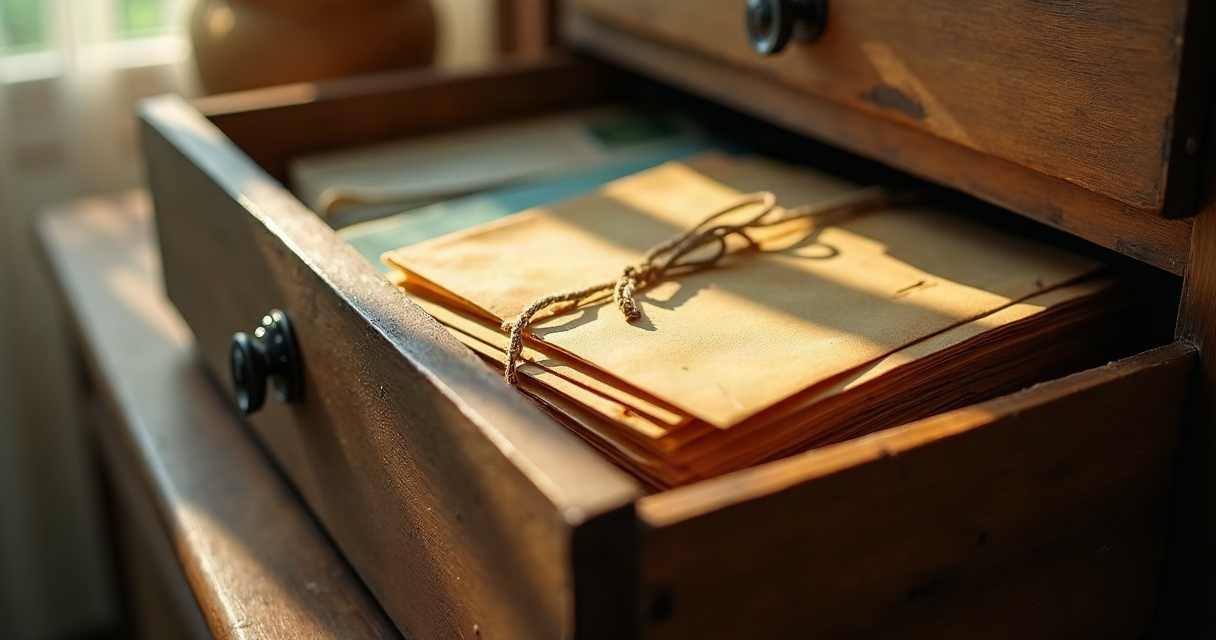
Many French families own a shoebox. Inside, yellowed cards written in pencil in a cramped hand, signed by a great-grandfather nobody alive ever met. "My dear little wife, I'm writing these few lines to tell you I am still in good health…" With 11 November, Armistice Day, just around the corner, we felt like opening the box again. Because between 1914 and 1918 the postcard did more work than at any other time in its history: for millions of soldiers and their families, it was the only thread that still held.
Millions of cards a day
From the first days of August 1914, soldiers' mail became free of charge, the franchise militaire. All a man had to do was write "F.M." in the top right corner, where the stamp would have gone. The army even printed its own cards, decorated with tricolour flags and the words "Correspondance des armées de la République". The volume outstripped anything the post office had ever seen: several million letters and cards travelled between the front and home every single day, in both directions. Field post offices, the Trésor et Postes, were set up as close to the lines as possible to sort it all. Out there the postman was called the vaguemestre: he carried the mail down into the trenches and brought the men's cards back up. On the day he came, everyone stood up.
An address with no place name
Look at the address on the back of a poilu's card (poilu, "the hairy one", was the nickname of the French infantryman) and you'll find no town, no village, no front. Just a name, a regiment, a company and a secteur postal number. The system was designed so that nobody reading an envelope could tell where a unit was. The soldier wrote "S.P. 112" and only the post office knew where that landed. The reverse was true too: from the trench, a man wrote to an ordinary village address, street name and all, and his card crossed France in a few days to drop into a letterbox that someone checked every morning.
"All is well": three words you read between the lines
The poilus' cards nearly all sound alike. They talk about health, the weather, the parcel that arrived, news from the village, the harvest, the little one who must be growing. They say "all is well", "don't fret", "we're resting behind the lines". Rarely what was actually happening. There are two reasons. The first is official: from 1916, postal control boards opened a share of the mail and could black out lines. The second is more human, and stronger: you don't describe horror to your mother on ten centimetres of cardboard. You reassure her. A century later it is precisely these ordinary cards that move us most: the silence between the lines says everything the pencil left out.
Embroidered silks and wartime godmothers
Among the cards of those years are some of the most beautiful ever made: the embroidered silks. Bouquets, flags, swallows, "Souvenir de France", stitched by hand on a square of silk and mounted on embossed card. Women in northern France and Belgium embroidered them by the thousand; soldiers bought them behind the lines to send to a sweetheart or a mother. And then there were the marraines de guerre, the wartime godmothers. From 1915, women all over France began writing to soldiers who had no one: no family, a village under occupation, a fiancée who had stopped replying. A card, a parcel, another card. Some of these correspondences lasted the whole war, and a few ended in a wedding. All of it with a pencil, some paper and a letterbox.
What the shoebox teaches us
These cards survived everything: mud, censorship, house moves, an entire century. They survived because they are paper, because someone held them and put them away somewhere. A digital message from 1916, had such a thing existed, would be long gone. If there is a box like that at your parents' or grandparents' place, 11 November is the right moment to open it and let the children read: the handwriting, the old-fashioned turns of phrase, the address with no town. And perhaps to send a card of your own. Not to talk about the war, but to say "all is well, I'm thinking of you" to someone who, at the other end of France, still checks the letterbox. With UnCoucou you pick your photo (why not a shot of great-grandfather's card lying on the kitchen table), write your message from wherever you are in the world, and we print your card on thick premium paper and hand it to La Poste at our next dispatch, at least one a week; then allow 2 to 5 working days for it to reach a letterbox in France or Monaco, from €2.49 per card, stamp included. The pencil is no longer compulsory. Simple words still work.