Mountain photography: a postcard that does the view justice
Published on 27 July 2026 · 3 min read
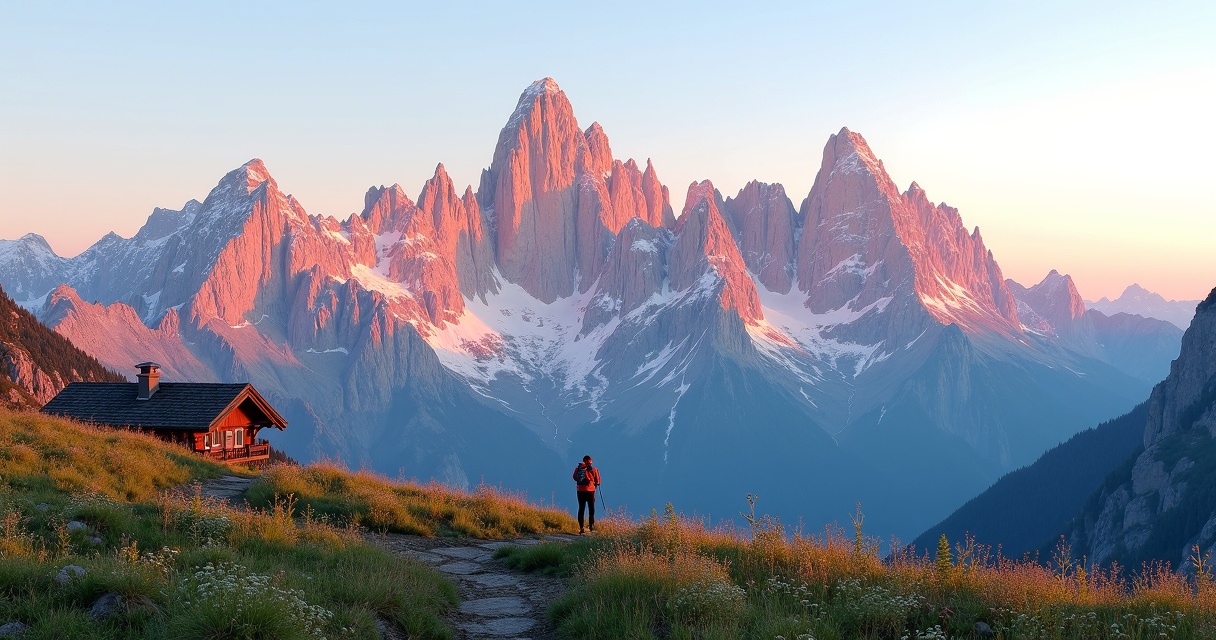
You’re back from the hike, scrolling through your photos, and it’s the same letdown every time: the panorama that took your breath away looks like a small grey hill on screen. Mountains are the hardest subject to photograph, because what stuns you up there is the sense of scale — and a photo flattens scale. The good news: a few simple habits are enough to keep your summit looking mighty, even printed as a 10x15 postcard.
Give your landscape a sense of scale
A mountain range alone in the middle of the frame has no reference point: nothing says whether it’s 300 or 3,000 metres high. Add an element whose size everyone knows: your hiking buddy on the trail, a mountain hut, a herd of cows, a small chapel. On a postcard, that tiny figure facing the rock face instantly tells the story of how huge the place is. Think about the foreground too: wildflowers, a boulder, the edge of a lake. The eye enters the picture through that close detail, then travels up to the ridges — and that journey is exactly what creates depth.
Pick your hour (and your side)
At midday the light falls straight down: the relief disappears and everything looks flat. Early in the morning or late in the day, the sun skims the slopes and carves every ridge with long shadows. That’s when the mountain gains volume. If the summit turns pink at dawn or sunset, you’ve got your card. And don’t put your phone away when it’s overcast: clouds catching on the ridgeline make spectacular images, often livelier than a big empty blue sky.
Frame it for the postcard format
A postcard is read horizontally, in a single glance. Keep the horizon straight, place the ridgeline on the upper or lower third rather than dead centre, and resist the urge to fit everything in: one strong summit beats three cramped ranges. Finally, zoom in on the details to check the shot is sharp. Then all that’s left is to write three lines from the refuge and send it: straight from the app, your photo goes out as a real card from €2.49 all-inclusive, stamp included. Your panorama will end up magnet-pinned to a fridge instead of buried in your camera roll.